Αρχείο:PIA19087-MarsCuriosityRover-GaleCrater-MethaneChart-20141216.png


Σύνοψη
| Περιγραφή |
English: December 16, 2014
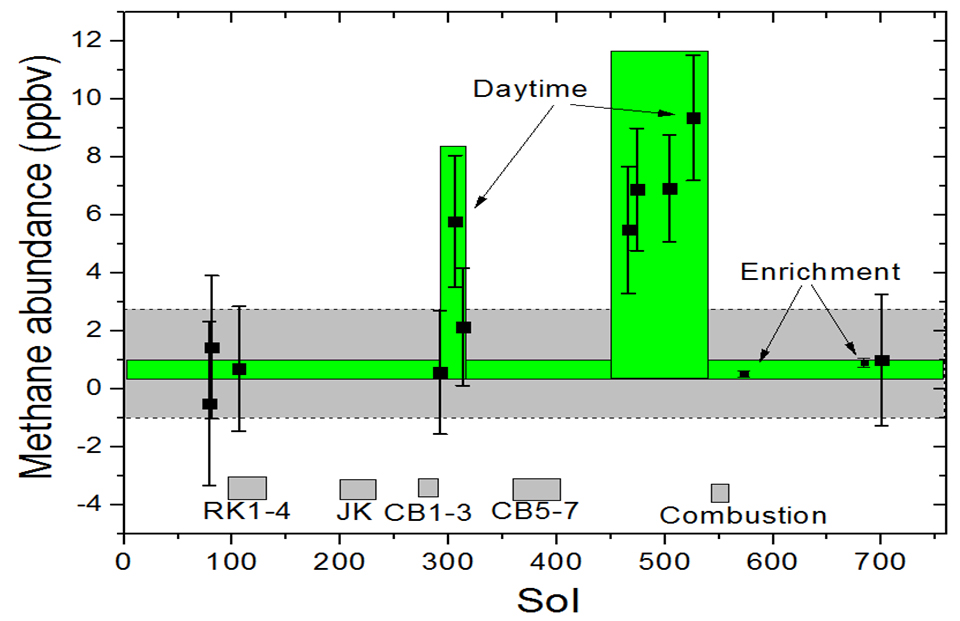
Methane Measurements by NASA's Curiosity Mars Rover http://mars.jpl.nasa.gov/msl/multimedia/images/?ImageID=6890 This graphic shows tenfold spiking in the abundance of methane in the Martian atmosphere surrounding NASA's Curiosity Mars rover, as detected by a series of measurements made with the Tunable Laser Spectrometer instrument in the rover's Sample Analysis at Mars laboratory suite. Image Caption: Methane Measurements by NASA's Curiosity in Mars' Gale Crater This graphic shows tenfold spiking in the abundance of methane in the Martian atmosphere surrounding NASA's Curiosity Mars rover, as detected by a series of measurements made with the Tunable Laser Spectrometer (TLS) instrument in the rover's Sample Analysis at Mars (SAM) laboratory suite. The graph covers a span of time from August 2012 to September 2014, labeled on the horizontal axis by the number of sols, or Martian days, since the rover's landing on Mars -- sols 1 through 750. The TLS measurements are indicated by small black squares on the graph, each with a vertical bar representing the margin of uncertainty in that sol's measurement. The measurements cover a 20-month span. Methane concentration in the Martian atmosphere samples climbed to several parts per billion by volume (ppbv, meaning several methane molecules per billion molecules of Martian atmosphere) during a short portion of that period. It averaged about 7 ppbv in those measurements. Both before and after the spike, the measured concentration was at or below about 1 ppbv, averaging 0.7 ppbv. The TLS technology from Curiosity is being tested for use on Earth as utility-company safety equipment to check for leaks in pipelines carrying natural gas. Methane is a major component of natural gas. NASA's Mars Science Laboratory Project is using Curiosity in Mars' Gale Crater to assess ancient habitable environments and major changes in Martian environmental conditions. NASA's Jet Propulsion Laboratory, a division of the California Institute of Technology, Pasadena, built the rover and manages the project for NASA's Science Mission Directorate, Washington. JPL developed and built the TLS. NASA's Goddard Space Flight Center, Greenbelt, Maryland, built and operates SAM. |
| Ημερομηνία | |
| Πηγή | http://mars.jpl.nasa.gov/msl/images/methane-chart-mars-rover-curiosity-gale-crater-pia19087-full.jpg |
| Δημιουργός | NASA/JPL-Caltech |
Αδειοδότηση

|
Ο κάτοχος των πνευματικών δικαιωμάτων αυτού του αρχείου, NASA/JPL-Caltech , επιτρέπει σε οποιονδήποτε να το χρησιμοποιήσειγια οποιονδήποτε σκοπό, υπό τον όρο ότι για τον κάτοχο των πνευματικών δικαιωμάτων θα γίνεται κατάλληλη αναφορά. Αναδιανομή, τροποποίηση, εμπορική χρήση, και όλες οι άλλες χρήσεις επιτρέπονται. |
|
|
 
|
According to JPL's image use policy additional restriction is that no endorsement of any product or service by Caltech, JPL or NASA is claimed or implied.
Caltech's disclaimer: Caltech makes no representations or warranties with respect to ownership of copyrights in the images, and does not represent others who may claim to be authors or owners of copyright of any of the images, and makes no warranties as to the quality of the images. Caltech shall not be responsible for any loss or expenses resulting from the use of the images, and you release and hold Caltech harmless from all liability arising from such use. Usage on the English Wikipedia: On the English Wikipedia you can use the {{JPL Image}} template to display the copyright notice. (See w:Wikipedia:Using JPL images for details) |
Ιστορικό αρχείου
Πατήστε σε μια ημερομηνία/ώρα για να δείτε το αρχείο όπως εμφανιζόταν εκείνη την χρονική στιγμή.
| Ημερομηνία/Ώρα | Μικρογραφία | Διαστάσεις | Χρήστης | Σχόλιο | |
|---|---|---|---|---|---|
| τρέχον | 21:22, 17 Δεκεμβρίου 2014 | | 960 × 621 (146 KB) | wikimediacommons>Drbogdan | User created page with UploadWizard |
Χρήση αρχείου
Η ακόλουθη σελίδα χρησιμοποιεί προς αυτό το αρχείο:
